Draft NIST Guidelines Rethink Cybersecurity for the AI Era

Artificial intelligence (AI) is impacting many organizations’ activities, and cybersecurity is no exception. For anyone interested in the opportunities and risks at the intersection of cybersecurity and AI, the National Institute of Standards and Technology (NIST) has released a preliminary draft of its Cyber AI Profile.
The publication, whose full title is the Cybersecurity Framework Profile for Artificial Intelligence (NISTIR 8596), offers guidelines for using the NIST Cybersecurity Framework (CSF 2.0) to accelerate the secure adoption of AI. The profile helps organizations think about how to strategically adopt AI while addressing emerging cybersecurity risks that stem from AI’s rapid advance.
“Regardless of where organizations are on their AI journey, they need cybersecurity strategies that acknowledge the realities of AI’s advancement,” said Barbara Cuthill, one of the profile’s authors.
The draft resulted from a yearlong effort on the part of NIST cybersecurity and AI experts. Over that time, more than 6,500 individuals have joined the community of interest to contribute to NIST’s development of the profile. After releasing an initial concept paper in February 2025, conducting a workshop the following April, and hosting a series of community of interest meetings in the summer, NIST is now releasing the preliminary draft of the profile for a 45-day public comment period.
The Cyber AI Profile centers on three focus areas:
- Securing AI systems: identifying cybersecurity challenges when integrating AI into organizational ecosystems and infrastructure
- Conducting AI-enabled cyber defense: identifying opportunities to use AI to enhance cybersecurity, and understanding challenges when leveraging AI to support defensive operations
- Thwarting AI-enabled cyberattacks: building resilience to protect against new AI-enabled threats
“The three focus areas reflect the fact that AI is entering organizations’ awareness in different ways,” Cuthill said. “But ultimately every organization will have to deal with all three.”
The Cyber AI Profile can help organizations use the CSF to crystallize their cybersecurity goals with respect to AI and CSF 2.0. The profile offers insights to help organizations understand, examine and address the cybersecurity concerns related to AI and thoughtfully integrate AI into their cybersecurity strategies.
NIST uses the term “community profile” to describe the application of CSF 2.0 to address shared interests and goals among organizations. The Cyber AI Profile joins other community profiles that NIST has created for the manufacturing, financial and telecommunications communities, among others.
The preliminary draft release is intended to seek feedback from the public to inform an initial public draft, which Cuthill says will further refine the profile and include mapping of additional relevant resources to the CSF. Following the 45-day comment period, NIST plans to develop the initial public draft for release in 2026.
When finalized, the profile will help organizations incorporate AI into their cybersecurity planning by suggesting key actions to prioritize, highlighting special considerations from specific parts of the CSF when considering AI, and providing mappings to other NIST resources, including the AI Risk Management Framework.
Cuthill said the authors hope to continue developing the profile as a tool that will prove useful to the community.
“The Cyber AI Profile is all about enabling organizations to gain confidence on their AI journey,” she said. “We hope it will help them feel equipped to have conversations about how their cybersecurity environment will change with AI and to augment what they are already doing with their cybersecurity programs.”

NIST Launches Centers for AI in Manufacturing and Critical Infrastructure

The U.S. Department of Commerce’s National Institute of Standards and Technology (NIST) has expanded its collaboration with the nonprofit MITRE Corporation as part of its efforts to ensure U.S. leadership in artificial intelligence (AI). Through this award, NIST is investing $20 million to establish two centers to advance the delivery of AI-based technology solutions to strengthen U.S. manufacturing and cybersecurity for critical infrastructure.
“This investment will help accelerate the application of AI in American manufacturing and help drive the American manufacturing renaissance,” said Deputy Secretary of Commerce Paul Dabbar. “We can harness AI to increase the competitiveness of our manufacturers and attract investment in America.”
The award is an important step in implementing NIST’s Strategy for American Technology Leadership in the 21st Century to accelerate the progress of critical and emerging technologies from development to adoption, in close partnership with U.S. industry.
“Our goal is to remove barriers to American AI innovation and accelerate the application of our AI technologies around the world,” said Acting Under Secretary of Commerce for Standards and Technology and Acting NIST Director Craig Burkhardt. “This new agreement with MITRE will focus on enhancing the ability of U.S. companies to make high-value products more efficiently, meet market demands domestically and internationally, and catalyze discovery and commercialization of new technologies and devices.”
The AI Economic Security Center for U.S. Manufacturing Productivity and the AI Economic Security Center to Secure U.S. Critical Infrastructure from Cyberthreats will drive the development and adoption of AI-driven tools, or “agents,” in these two national priority areas. The centers will develop the technology evaluations and advancements that are necessary to effectively protect U.S. dominance in AI innovation, address threats from adversaries’ use of AI, and reduce risks from reliance on insecure AI.
NIST will rely on existing resources to build on its expertise and carry forward recommendations in the White House’s July 2025 America’s AI Action Plan, including Pillar I: Accelerate AI Innovation and Pillar II: Build American AI Infrastructure.
These are important first steps in NIST’s programmatic plan to coordinate innovation-based research efforts for accelerating the development and deployment of critical technologies in areas of national priority. Building on its long history of public-private collaboration, NIST plans to use adaptive and flexible partnerships to develop, pilot and implement new advances to establish U.S. leadership and innovation in critical and emerging technologies such as AI, quantum information science and technology, and biotechnology.
The partnership will leverage MITRE’s long-standing mission to operate federally funded research and development centers. NIST expects the AI centers to enable breakthroughs in applied science and advanced technology and deliver disruptive innovative solutions to tackle the most pressing challenges facing the nation.
This agreement expands NIST’s portfolio of AI-focused programs and builds on the private-public partnerships leveraged by the Center for AI Standards and Innovation (CAISI), which leads evaluations of U.S. and adversary systems and contributes to NIST’s efforts to develop best practices. CAISI has established voluntary agreements with multiple developers of leading-edge or “frontier” AI models to enable collaborative research and voluntary testing of industry models for priority national security capabilities.
In the coming months, NIST plans to announce its award for the AI for Resilient Manufacturing Institute, through the Manufacturing USA program. With up to $70 million in investment over a five-year period from NIST and at least that much in nonfederal funding, the institute will bring together expertise in AI, manufacturing and supply chain networks to promote manufacturing resilience.
Combined, these efforts will enhance NIST’s core research, standards and technology mission to tackle barriers preventing U.S. innovation and leadership in AI.

NSA Releases First in Series of Zero Trust Implementation Guidelines

The National Security Agency (NSA) is releasing the first two products in a series of Zero Trust Implementation Guidelines (ZIGs) to provide practical, actionable recommendations to facilitate the implementation of Zero Trust (ZT).
This series of reports outlines the steps to implement the technologies and processes that support achieving the Target-level ZT Capabilities, Activities, and Expected Outcomes described in the Department of War (DoW) CIO ZT Framework.
The Primer and Discovery Phase are the gateway to ZT implementation, providing guidance and direction to ensure organizations are fully equipped to digest and implement the Phase 1 and Phase 2 ZIGs upon their release.
The Primer outlines the strategy and principles used to develop the ZIGs and provides a holistic approach to maximizing the usage of the series. Notably, the ZIGs are designed to be modular, allowing organizations at different levels of ZT maturity to select and implement the capabilities most relevant to the needs of their environment.
The Discovery Phase is intended to help organizations establish foundational visibility and understand the critical data, applications, assets, and services, as well as access and authorization activity existing within the architecture. The goal of this initial phase is to enable informed prioritization and planning by creating a reliable baseline that supports effective ZT implementation.
System owners, cybersecurity professionals, and stakeholders should review these foundational guidelines to gain a deeper understanding of ZT activities and their organization’s operational landscape in preparation for the release of the Phase 1 and Phase 2 ZIGs.

New report explores use of robotics and unmanned systems in the fight against crime

Europol has published The Unmanned Future(s): The Impact of Robotics and Unmanned Systems on Law Enforcement. The report, produced by the Europol Innovation Lab, provides an in-depth analysis of how unmanned systems could change society, crime and law enforcement, and discusses the challenges and opportunities they present.
The report underscores the rapid advancement and integration of unmanned systems in various sectors, including law enforcement. As these technologies become more sophisticated and widespread, they offer new opportunities for law enforcement operations and operational support. However, they also introduce new security threats – such as misuse by criminal and terrorist groups – and regulatory challenges that law enforcement agencies must address to ensure public safety and maintain trust.
"The integration of unmanned systems into crime is already here, and we have to ask ourselves how criminals and terrorists might use drones and robots some years from now. Just as the internet and smartphones presented significant opportunities as well as challenges, so will this technology. Our new report by Europol’s Innovation Lab explores the future operating environment for European law enforcement agencies and suggests actions needed today in order to effectively combat crime while upholding public trust and fundamental rights tomorrow." said Catherine De Bolle,Europol Executive Director.
One chapter of the report highlights the role of war as a driver for innovation in unmanned systems. Recent conflicts, such as the ongoing Russian war of aggression against Ukraine, have accelerated the development and deployment of advanced unmanned systems. The lessons learnt from these conflicts are invaluable for law enforcement agencies in Europe as they prepare for the future operating environment.
Some of the key topics covered in the report include:
Increasing use of unmanned systems
Unmanned systems are becoming increasingly useful, affordable and widely available, with applications in both public and private sectors. Law enforcement agencies across Europe are scaling up adoption of such systems, including drones and robots, to enhance situational awareness, improve safety and extend operational reach. These systems are employed for a range of tasks, such as monitoring, crime scene mapping, search and rescue operations, and the disposal of explosive ordnance, among others. Converging technologies present a significant opportunity for a breakthrough in the capabilities of unmanned systems.
Technical and regulatory challenges
The report highlights significant technical limitations and regulatory gaps that hinder the effective use of unmanned systems in law enforcement. Issues such as limited autonomy, dependence on industrial suppliers and the lack of clear guidelines for autonomous operations pose substantial challenges.
Security threats
Criminal and terrorist groups are rapidly adopting unmanned systems for illicit activities. The report warns of the potential for these systems to be used for criminal surveillance, smuggling and even attacks. The increasing accessibility and versatility of drones, in particular, present serious security concerns.
Public trust and regulation
Public trust is crucial for the legitimacy of law enforcement capabilities. The report emphasises the need for transparency, accountability and public engagement in the deployment of unmanned systems. Current regulations, while advancing, still have gaps, particularly in addressing non-compliant or criminal use.
Future operating environment
The future of law enforcement will require policing in a three-dimensional space, as unmanned systems operate in the air and on the ground, as well as on and under water. This shift will necessitate new strategies, technologies and training for law enforcement agencies.
Recommendations
The report provides a set of recommendations for European law enforcement agencies, including the development of a strategic direction, the establishment of a competency hub and the integration of unmanned systems into existing information systems. It also calls for investments in training, education and public trust-building initiatives.
The report is available for download on the Europol website and includes detailed insights, case studies and recommendations for law enforcement agencies, policymakers and other stakeholders.

CISA Unveils Enhanced Cross-Sector Cybersecurity Performance Goals

New Benchmarks Empower Organizations to Counter Emerging Threats, Build Cyber Resilience, and Strengthen Governance
the Cybersecurity and Infrastructure Security Agency (CISA) released version 2.0 of its Cross-Sector Cybersecurity Performance Goals (CPGs), offering organizations a more robust framework for integrating cybersecurity into daily operations. The updated CPGs align with the National Institute of Standards and Technology (NIST) Cybersecurity Framework (CSF) 2.0, incorporates three years of operational insights, and address emerging threats through data-driven, actionable guidance. These enhancements are designed to promote accountability, improve risk management, and support strategic cybersecurity governance across sectors.
The Cross-Sector CPGs represent a targeted subset of best practices, carefully selected through extensive consultation with industry leaders, government stakeholders, and cybersecurity experts. Designed to meaningfully reduce risks to critical infrastructure and safeguard the American public, these goals offer a practical starting point for small and medium-sized organizations. By focusing on a limited set of high-impact actions, the CPGs help prioritize cybersecurity investments that deliver measurable improvements in resilience and risk reduction.
The updated goals offer expanded and clarified guidance across key cybersecurity domains—including account and device security, data protection, governance, vulnerability management, supply chain risk, and incident response and recovery. Building on the foundation of version 1.0.1, CPG 2.0 introduces several notable improvements:
- Governance Emphasis: A new “Govern” function underscores the critical role of organizational leadership in cybersecurity, regrouping existing goals and introducing two new ones focused on risk management strategy, policy development, and executive accountability.
- Unified Goal Structure: Operational Technology (OT) and Information Technology (IT) goals are now consolidated into universal goals, eliminating silos across IT, Internet of Things (IoT), and OT environments.
- Threat-Responsive Expansion: New goals address emerging threats, third-party risk, zero trust architecture, and incident communication protocols.
- Streamlined Framework: Redundant, unclear, or underutilized goals have been removed to improve clarity and usability.
- Enhanced Documentation: Each goal now includes clearer methodology and supporting materials to reduce guesswork and improve implementation.
“Over the past year, CISA has engaged extensively with hundreds of stakeholders across both the public and private sectors to ensure the updated goals reflect real-world challenges and operational realities,” said Madhu Gottumukkala, Acting CISA Director. “Version 2.0 demonstrates our commitment to listening to and incorporating partner feedback to deliver practical, outcome-driven guidance that organizations can act on. These goals are applicable across all critical infrastructure sectors and offer foundational protection for organizations regardless of their cybersecurity maturity. We encourage all organizations to adopt the new CPGs and continue sharing feedback to help us refine future iterations.”
The Cross-Sector CPGs serve three primary purposes:
- Provide measurable actions that critical infrastructure entities can take to achieve a basic level of cybersecurity.
- Bridge communication gaps between IT/OT technical staff and organizational leadership to align on cybersecurity priorities.
- Support strategic planning by offering clear guidance that informs both near- and long-term cybersecurity investments.
CISA encourages organizations to adopt the voluntary Cross-Sector CPGs. To learn more about the updated Cybersecurity Performance Goals and how they can support your organization’s cybersecurity program, visit Cross-Sector Cybersecurity Performance Goals and Objectives.

CISA Releases Dynamic New Guide for Stadium and Arena Owners to Fortify Operations, Mitigate Vulnerabilities and Elevate Emergency Preparedness

The Cybersecurity and Infrastructure Security Agency (CISA) released the Venue Guide for Mitigating Dependency Disruptions, a new resource designed to strengthen the resilience of public gathering venues. This guide provides stadium and arena owners and operators with baseline strategies to mitigate the consequences of potential disruptions to four critical lifeline sectors—including Energy, Water and Wastewater Systems, Communications, and Transportation.
CISA developed this guide in close collaboration with government and industry experts from the four lifeline sectors as a concise, actionable resource for stadium and arena owners. Tailored for major public gathering events- such as FIFA World Cup 2026, America 250, and 2028 Summer Olympics, the guide draws on lessons learned from recent disruptions at high-profile public gathering sports and entertainment facilities across the United States and internationally. It equips critical infrastructure stakeholders with a clear understanding of threats to lifeline sectors and provides effective strategies to safeguard operations, reduce vulnerabilities, and enhance preparedness.
“Today’s risk environment is rapidly evolving, posing serious threats and disruptions to U.S. critical infrastructure and public gathering venues,” said CISA Acting Director Madhu Gottumukkala. “CISA is committed to working hand-in-hand with our government and industry partners to deliver actionable guidance that helps mitigate these risks. This guide empowers venue owners and operators to proactively assess vulnerabilities tied to dependent lifeline services and integrate those insights into contingency planning—ultimately reducing potential consequences and strengthening operational resilience.”
The Venue Guide for Mitigating Dependency Disruptions aligns with Executive Order 14234 Establishing the White House Task Force on the World Cup 2026, Executive Order 14239 Achieving Efficiency through State and Local Preparedness, and Executive Order 14328 Establishing the White House Task Force on the 2028 Summer Olympics. This guide assists critical infrastructure and public venue owners and operations with:
- Understanding the lifeline sector dependencies and interdependencies that their venues may rely on;
- Assessing security risks and associated key components of a facility evaluation; and
- Focusing on continued information-sharing and relationship-building with key partners such as local services providers, first responders, and CISA Security Advisors.
“Robust partnerships are essential to safeguarding critical infrastructure and public gatherings. By sharing threat intelligence, risk mitigation strategies, and other vital information, we strengthen our collective ability to anticipate and respond to potential disruptions. CISA’s newly released guide empowers venue owners and operators to assess dependencies and implement targeted mitigation strategies,” said CISA Executive Assistant Director for Infrastructure Security Steve Casapulla. “We deeply value the insights and collaboration from our government and industry partners across four lifeline sectors, which were instrumental in shaping this timely and practical resource. CISA urges all organizations that host events to review the guide and take proactive steps to enhance infrastructure security and resilience.”

Mistaking AI vulnerability could lead to large-scale breaches, NCSC warns

NCSC raises alert on “dangerous” misunderstanding of emergent class of vulnerability in generative artificial intelligence (AI) applications.
The National Cyber Security Centre (NCSC) – a part of GCHQ – has shared critical insights cautioning cyber security professionals against comparing prompt injection and more classical application vulnerabilities classed as SQL injection.
A new blog advises that, contrary to first impressions, prompt injection attacks against generative artificial intelligence applications may never be totally mitigated in the way SQL injection attacks can be.
Unlike SQL mitigation techniques, which hinge on enforcing a clear separation between data and instructions, prompt injection exploits the inability of large language models (LLMs) to distinguish between the two.
Without action addressing this misconception, the NCSC warns, websites risk falling victim to data breaches exceeding those seen from SQL injection attacks in the 2010s, impacting UK businesses and citizens into the next decade.
Backing proactive adoption of cyber risk management standards, the NCSC challenges claims that prompt injections can be ‘stopped’.
Instead, it suggests efforts should turn to reducing the risk and impact of prompt injection and driving up resilience across AI supply chains.
As AI technologies become embedded in more UK business operations, the NCSC calls on AI system designers, builders and operators to take control of manageable variables, acknowledging that LLM systems are “inherently confusable” and their risks managed in different ways.

Terrorist Watchlist: FBI Should Improve Outreach Efforts to Nonfederal Users

The Threat Screening Center, administered by FBI, is responsible for managing the terrorist watchlist. In recent years, Members of Congress have raised questions about how nonfederal entities use the terrorist watchlist.
GAO was asked to examine the use of the terrorist watchlist by nonfederal law enforcement entities. This report examines (1) nonfederal entities’ reporting of terrorist watchlist encounters to FBI and opportunities for improvement and (2) steps FBI has taken to ensure nonfederal entities’ awareness of watchlist policies through outreach and state-led trainings.
When state and local law enforcement officers encounter people—e.g., in traffic stops—officers check their names against state database systems. The systems will return an alert if a name potentially matches one on the terrorist watchlist, which is managed by the FBI.
In half the interviews with law enforcement agencies, officials said their officers may not always know how to properly respond to these alerts.
We recommended that the FBI develop a communications plan to tell law enforcement agencies about the policies around the terrorist watchlist, and a process to review states' training on the policies.
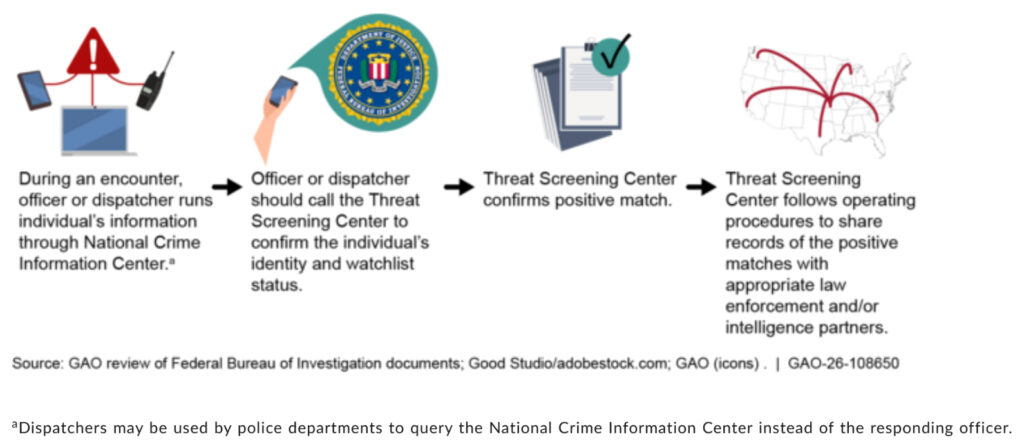
Nonfederal law enforcement officers query encountered individuals against the terrorist watchlist during routine police interactions, such as traffic stops. After encountering a potentially terrorist watchlisted individual, nonfederal law enforcement officers receive instructions, via the National Crime Information Center (NCIC), to contact the Federal Bureau of Investigation’s (FBI) Threat Screening Center to determine whether the individual is a positive or negative match to the terrorist watchlist.
GAO found that almost half of the law enforcement entities GAO interviewed in four states (12 of 26 entities, including police and sheriff’s departments) reported that officers were not consistently reporting encounters with potentially terrorist watchlisted individuals in instances where it is warranted. Seeking information to understand the extent to which nonfederal law enforcement entities are consistently reporting terrorist watchlist encounters could improve the accuracy of watchlist records.
Nonfederal Law Enforcement Steps When Responding To Terrorist Watchlist Encounters
The Threat Screening Center uses outreach efforts to communicate terrorist watchlisting policies to nonfederal law enforcement entities that use the terrorist watchlist. However, GAO found that FBI has not ensured nonfederal law enforcement entities are aware of terrorist watchlist policies and has not taken steps to develop a communication plan for its outreach efforts. Developing a communication plan with goals and measures as well as periodic assessments of progress would help accomplish this. Additionally, FBI’s Criminal Justice Information Services does not ensure states train NCIC users on terrorist watchlist policies. Without developing a process to review states’ efforts to do so, FBI cannot ensure that state training programs instruct nonfederal law enforcement to properly protect and respond to terrorist watchlist information.
GAO reviewed watchlist policies and training resources for nonfederal entities and collected encounter data for fiscal years 2019 through 2024. GAO interviewed nonfederal law enforcement officials in four states selected based on the number of encounters and other factors. While not generalizable, these interviews provided insights into officials’ awareness of policies and training.
This is the public version of a sensitive report GAO issued in August 2025. Information on encounter data and official FBI instructions on handling watchlist encounters that FBI deemed sensitive has been omitted.
GAO recommends that FBI (1) seek information to understand the extent to which nonfederal law enforcement entities are consistently reporting terrorist watchlist encounters, (2) develop a communication plan to improve its outreach efforts, and (3) develop a process to review state efforts to instruct NCIC users about watchlist policies. FBI concurred with the recommendations.

CISA Launches New Platform to Strengthen Industry Engagement and Collaboration

The Cybersecurity and Infrastructure Security Agency (CISA) launched a new Industry Engagement Platform (IEP) designed to facilitate structured, two-way communication between the agency and companies developing innovative and security technologies. The IEP enables CISA to better understand emerging solutions across the technology ecosystem while giving industry a clear, transparent pathway to engage with the agency.
“With the launch of this new platform, we’re opening the door wider to innovation—giving industry a direct line to share the tools and technologies that can help CISA stay ahead of evolving threats,” said CISA Acting Director Madhu Gottumukkala. “The private sector drives innovation and this collaboration is essential to our national resilience.”
The IEP allows organizations – including industry, non-profits, academia, government partners at all and the research community – with a structured process to request conversations with CISA subject matter experts to describe new technologies and capabilities. These engagements give innovators the opportunity to present solutions that may strengthen our nation’s cyber and infrastructure security.
Through customizable technology profiles, the IEP helps connect organizations to the right CISA experts by capturing areas of expertise and specific topics organizations wish to discuss. Participants may also upload capability overviews for CISA to reference in market research and in understanding emerging technologies across sectors.
While participation in the IEP does not provide preferential consideration for future federal contracts, it serves as a key channel for CISA to gain insight into new capabilities and market trends that support mission needs.
CISA encourages organizations with new, emerging, or advanced technology solutions to visit the Industry Engagement Platform. Current areas of interest include:
- Information technology and security controls
- Data, analytics, storage, and data management
- Communications technologies
- Any emerging technologies that advance CISA’s mission, including post-quantum cryptography and other next-generation capabilities
“Strategic collaboration is essential to strengthening national security and resilience,” Gottumukkala added. “The IEP is one of the ways CISA is aligning innovation with mission needs to advance the defense of our nation’s cyber and critical infrastructure.”

Key international organizations align on AI standards

International standardization bodies have pledged to cooperate on standards for artificial intelligence (AI), aiming to help build an open, sustainable and secure future for all.
The International Electrotechnical Commission (IEC), the International Organization for Standardization (ISO), and the International Telecommunication Union (ITU), at their latest global meeting in Seoul, Republic of Korea, issued a joint commitment to advance the well-being of humanity through AI standards.
The International Summit on AI Standards explores the complex challenges posed by AI and the opportunity to bridge digital divides through effective international standards.
The Seoul Statement enshrines a joint by the three organizations to advance AI standards for the benefit of everyone worldwide.
“Standards are technical tools to uphold the principles we want to live by,” said Seizo Onoe, Director of the Telecommunication Standardization Bureau at ITU. “The vision set out by this joint statement calls for diverse expertise and global commitment to collaboration and consensus – exactly what drives our standards work and exactly the spirit needed to create the future we want.”
A shared vision of AI for humanity
The statement sets out a joint vision and commitments from ITU, ISO and IEC on how technical standards can support the development and deployment of trustworthy AI systems that benefit society, drive innovation, and uphold fundamental rights.
“AI has the potential to bring profound benefits to people and economies across the globe,” said ISO President Sung Hwan Cho. “But to ensure this potential is realized equitably and responsibly, International Standards are essential. This joint statement reflects our commitment to strengthening cooperation across our organizations to deliver relevant, robust and human-centric standards that guide the responsible design and use of AI technologies.”
The summit brought together over 300 participants from 65 countries to share perspectives from government, industry, academia, civil society, the public and private sectors, international organizations and UN agencies.
Reliability and sustainability are crucial for standards to advance the global good. So is respect for human rights.
“The rapid rise of AI confirms a basic truth: technology is always about people,” said IEC President Jo Cops. “As AI becomes central to the global economy, we must urgently establish a guiding framework. This joint commitment underscores the value of international standards as the blueprint for safe, trustworthy, and people-centered AI development.”
Key commitments
The Seoul Statement outlines four key commitments to advance sustainable development and allow everyone to benefit from the AI revolution.
Together, IEC, ISO and ITU have pledged to:
- Actively incorporate socio-technical dimensions in standards development.
- Deepen the understanding of the interplay between international standards and human rights, recognizing both their importance and universality.
- Strengthen an inclusive, dynamic multistakeholder community to develop and apply international standards for the design, deployment, and governance of AI.
- Enhance public-private collaboration on AI capacity building.
1 2 3 4 5 59